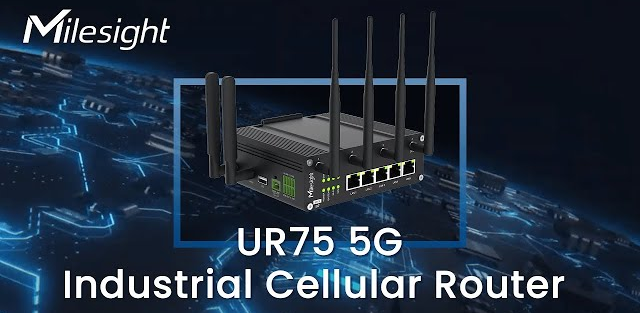
Milesight UR75
The Milesight UR75 is a fully industrial-grade 5G router built for the kind of environments where consumer hardware fails within weeks. Sub-zero warehouses, outdoor cabinets, mobile plant machinery, critical infrastructure sites. It is not cheap. It is not simple. And it does not apologise for either of those things.
This review covers the hardware, the software platform, the VPN stack, the cloud management layer, and where the UR75 sits relative to the rest of the Milesight industrial router range. If you are evaluating this device for a deployment, read it end to end before you decide.
Hardware and Build Quality
The UR75 is a metal-bodied DIN-rail router. It is built to IEC 60068 standards, rated for operation between -40°C and +70°C, and carries IP30 ingress protection. That combination covers the majority of industrial deployment scenarios, from outdoor telecoms cabinets in northern winters to hot automation panels.
The chassis is compact – roughly 140mm wide – but dense. Power input runs from 9V to 48V DC, covering both 12V and 24V industrial power rails without any additional conversion. That matters in the field, where power rails are what they are and you do not want an extra component in the circuit.
Physical connectivity on the UR75 includes:
- 4 x Gigabit Ethernet LAN ports
- 1 x Gigabit Ethernet WAN port
- 2 x SIM card slots (standard 1FF/2FF)
- RS232 and RS485 serial ports
- USB 2.0 host port
- Digital I/O (input and output)
- Antenna ports: 5G main and diversity, GPS, Wi-Fi (on Wi-Fi variants)
The serial ports are particularly important in industrial contexts. RS485 is the dominant bus in Modbus-based sensor and metering networks. Having that interface built into the router itself – rather than requiring a separate serial-to-IP converter – removes a failure point and simplifies cabinet design.
Build quality is Milesight’s strongest differentiator at this price point. The metal chassis does not flex under pressure. The SIM card slots are recessed and solid. Connectors are locking industrial types. This is hardware you can trust to a 5-year maintenance cycle.
5G Connectivity and SIM Handling
The UR75 uses a 5G Sub-6GHz modem. It is not mmWave, which is the right call for industrial deployments – mmWave coverage remains patchy outside dense urban cores and does not penetrate walls or vegetation. Sub-6GHz gives you the speed uplift over LTE that actually matters in the field: faster data transfer, lower latency, and better congestion performance on busy masts.
The Cat specification on the integrated modem supports downlink speeds competitive with standalone 5G NR deployments. In practice, on a well-served 5G mast with low contention, you will see 300-600 Mbps downlink. On a busy urban mast or at range, expect more typical LTE-class performance – which is fine for the applications this device targets.
Dual-SIM handling on the UR75 is genuinely useful and not just a checkbox feature. The device supports:
- Primary/backup failover with configurable detection thresholds
- Signal strength based switching
- Manual SIM selection
- Independent APN configuration per SIM slot
For critical infrastructure, the dual-SIM architecture allows you to run a primary commercial SIM alongside a backup on a different network – so a single operator outage does not drop the link. This is standard practice on RTU and SCADA deployments and the UR75 handles it cleanly.
The device also supports GNSS (GPS/GLONASS) positioning via an external antenna. For mobile or vehicle-based deployments, that gives you location data through the same management interface without needing a separate GPS module.
Software Platform and Routing Features
Milesight runs a Linux-based firmware on the UR75. The web UI is clean and logical, which is not a given in this product category – some industrial routers still ship with UIs that look like they were designed in 2003. The UR75 interface is usable without a manual, though you will want the manual open for the more advanced features.
Core routing and networking capabilities include:
- Static routing and policy-based routing
- OSPF and BGP dynamic routing protocols
- VLAN support (802.1Q)
- DHCP server and client
- DNS forwarding and static DNS entries
- NAT and port forwarding
- Bandwidth management and QoS
- Link aggregation and load balancing across WAN interfaces
The load balancing across cellular and Ethernet WAN is worth calling out. You can bond the 5G connection with a fixed broadband feed – ADSL, FTTC, or leased line – and have the device distribute traffic across both links. That is useful for bandwidth-hungry applications where you want cellular as supplementary rather than primary.
Python scripting is supported on the UR75 via a built-in interpreter. This is Milesight’s answer to the edge computing demand: you can run custom logic on the device itself, process local sensor data, apply filters, and reduce the volume of data being transmitted upstream. For IoT gateway applications, that matters. Sending every raw sensor reading to the cloud costs money and bandwidth. Processing at the edge and sending only meaningful events is the right architecture for most deployments.
The device also supports Modbus TCP gateway functionality. RS485 Modbus RTU devices on the serial port can be polled by a central system over the cellular link using standard Modbus TCP, with the UR75 acting as the protocol bridge. No extra software or middleware required.
VPN Stack – What You Get and How It Works
VPN capability on an industrial router is not just a feature – for most enterprise and critical infrastructure deployments, it is the primary reason for choosing cellular over fixed line. You need an encrypted tunnel back to your control network, full stop.
The UR75 supports all four major VPN protocols:
OpenVPN
Client and server mode. OpenVPN is the most widely deployed VPN protocol in industrial IoT for good reason: it is battle-tested, well-supported, and works across NAT without special configuration. The UR75 implementation supports certificate-based authentication, username/password, and combined auth. TLS 1.2 and 1.3 are both supported. If your VPN concentrator runs OpenVPN, this device will connect to it.
IPsec / IKEv2
Full IKEv1 and IKEv2 support with the standard suite of encryption and integrity algorithms (AES-128/256, SHA-1/256/384/512, DH groups 1 through 21). IPsec is the protocol of choice for site-to-site tunnels between the router and an enterprise firewall or VPN gateway – Cisco, Fortinet, Palo Alto, pfSense, StrongSwan. It interoperates cleanly with all of them. The UR75 supports both tunnel and transport mode, and policy-based as well as route-based VPN.
WireGuard
WireGuard support on an industrial router is a relatively recent addition across the category, and Milesight has implemented it properly. WireGuard’s cryptographic simplicity – Curve25519 key exchange, ChaCha20 encryption, Poly1305 authentication – makes it faster and lower overhead than OpenVPN or IPsec for equivalent security levels. For high-throughput applications or battery-constrained devices where CPU cycles matter, WireGuard is the right protocol to use.
GRE and L2TP
Generic Routing Encapsulation and L2TP are both present for compatibility with legacy infrastructure. GRE is unencrypted on its own but is often used in combination with IPsec for MPLS-style transport. L2TP/IPsec is a widely deployed combination for road warrior VPN access and for connecting to older Cisco or Juniper infrastructure.
Multi-Tunnel Deployment
The UR75 can run multiple VPN tunnels simultaneously. In practice, this means you can have a primary IPsec tunnel to your main data centre, a secondary OpenVPN tunnel as backup, and a WireGuard tunnel to a monitoring system – all active at the same time. Policy routing determines which traffic goes through which tunnel. That level of flexibility is genuinely useful on complex deployments.
Security Architecture
Security on the UR75 goes well beyond the firewall checkbox. Milesight has built a reasonably complete security stack for an industrial device.
Firewall
Stateful packet inspection firewall with zone-based policy. You define trust zones (LAN, WAN, DMZ) and configure inter-zone rules. Default deny outbound from WAN is sensible out of the box. The firewall supports both IPv4 and IPv6 rule sets.
Access Control
Web UI access can be restricted by source IP, limited to HTTPS only, and the default port changed. SSH access is similarly configurable. Multi-user accounts with role-based access control are supported, so you can give a monitoring team read-only access without handing over admin credentials.
Certificate Management
The device includes a certificate store for VPN authentication and can generate and manage X.509 certificates locally. For large deployments, certificates can be pushed via the DeviceHub management platform rather than configured manually per device.
Attack Prevention
Built-in protection against common network attacks: SYN flood, ICMP flood, port scan detection, ping of death. These are not deep packet inspection defences, but they handle the automated probing that any internet-facing interface will attract.
Secure Boot and Firmware Signing
Milesight firmware updates are cryptographically signed. The device verifies signature before applying any firmware image, preventing unauthorised or tampered firmware from being installed – which is a meaningful protection in remote deployments where physical access is difficult to audit.
Audit Logging
System logs, authentication events, and configuration changes are logged locally and can be forwarded to a remote syslog server. For compliance-oriented deployments – utilities, healthcare, financial infrastructure – that log trail is a requirement, not a nice-to-have.
DeviceHub Cloud Management
DeviceHub is Milesight’s proprietary cloud management platform for their router and IoT gateway estate. It is available as a SaaS service or as a self-hosted on-premise deployment, which gives you options depending on your data residency and security requirements.
What DeviceHub Gives You
Remote visibility is the core value. From a single dashboard you can see the status, signal strength, connected clients, VPN tunnel state, and uptime of every UR75 (and other compatible Milesight devices) in your fleet. For a deployment of 20 or 200 routers spread across a country, that centralised view is operationally critical.
Remote configuration is equally important. You can push configuration changes – including full config backups and restores – to individual devices or groups. Template-based provisioning means you can define a standard configuration and roll it out to multiple devices simultaneously. Zero-touch provisioning for new devices reduces the cost of deployment: devices arrive pre-registered in DeviceHub, connect to the network, and pull their configuration automatically.
Firmware management through DeviceHub lets you schedule and roll out firmware updates across your fleet in a controlled way. You can stage updates to a small group first, verify stability, and then roll out broadly. Given that firmware updates to remote devices carry operational risk, that staged rollout capability matters.
Alerts and Monitoring
DeviceHub supports threshold-based alerting on signal strength, data usage, device uptime, and tunnel state. Alerts can be delivered via email or webhook. For 24/7 operations teams, that proactive alerting is what separates managed connectivity from unmanaged connectivity.
Data Usage Tracking
Per-device data consumption is tracked in DeviceHub. On SIM contracts with data caps or pay-as-you-go IoT SIMs, knowing which device is consuming what – and being alerted when a device approaches its cap – prevents bill shock. This is a real operational concern on large IoT deployments.
API Integration
DeviceHub exposes a REST API, which means you can integrate router management into your own operational tooling, ticketing systems, or network management platforms. For organisations with existing NOC infrastructure, that integration path is the right approach rather than operating a separate siloed management tool.
Self-Hosted Option
The on-premise DeviceHub deployment is a container-based stack (Docker/Kubernetes) that you can run on your own infrastructure. For organisations with strict data sovereignty requirements, this is the deployment model to choose. The self-hosted version supports the same feature set as the SaaS offering.
Applications and Deployment Scenarios
The UR75 is designed for industrial IoT and critical communications. The following are the application areas where it performs best.
SCADA and RTU Connectivity
Water treatment, gas distribution, electricity distribution, and similar utility applications. The RS485 serial port connects directly to Modbus RTU meters and sensors. The cellular link carries data back to the SCADA head end over VPN. Dual-SIM failover protects link continuity. The -40°C cold start rating handles outdoor cabinet deployments in northern climates.
Smart Grid and Energy Metering
Advanced Metering Infrastructure (AMI) and smart grid monitoring. The UR75 sits at a substation or distribution cabinet, aggregating data from local meters and communicating with the grid operations centre. OSPF support allows integration into more complex grid communication architectures.
Digital Signage and Retail
Retail digital signage needs reliable connectivity without the cost of a leased line at every location. The UR75 provides that connectivity with the management capability to monitor and update sign content at scale. Dual-SIM failover ensures advertising uptime.
Vehicle and Mobile Platform
GNSS positioning, wide DC voltage input, and ruggedised construction make the UR75 suitable for vehicle-mounted deployments: buses, trains, emergency vehicles, utility vans. The 9-48V input range covers automotive 12V and 24V systems without modification.
Industrial Automation
Factory automation cells that need cloud connectivity for IIOT platforms. The Python scripting capability enables edge processing – reading sensor data via Modbus, filtering and aggregating it, and pushing structured data to platforms like AWS IoT, Azure IoT Hub, or Siemens MindSphere.
Critical Infrastructure Backup
Fixed-line backup for sites where the primary circuit is fibre or Ethernet. The UR75 sits dormant until the primary link fails, then the 5G link activates and VPN tunnels re-establish automatically. Failover times under 30 seconds are achievable with well-configured detection parameters.
UR75 Variants – Which One Do You Need?
Milesight produces the UR75 in several hardware configurations. The two main variants available through the Milesight 5G router range at RouterStore are:
Milesight UR75-504AE-W2
The standard 5G variant with Wi-Fi 6 (802.11ax). This is the right choice for the majority of deployments. 5G Sub-6GHz, dual SIM, 4 LAN ports, 1 WAN port, RS232/RS485, Wi-Fi 6 for local device connectivity. The W2 designation indicates the dual-band Wi-Fi module.
Milesight UR75-504AE-P-W2
The PoE variant. Identical specification to the W2 but with Power over Ethernet output on the LAN ports. If you have IP cameras, VoIP handsets, access control readers, or other PoE-powered devices at the same location, this variant removes the need for separate PoE injectors or switches. A meaningful cost and space saving in a compact installation cabinet.
Beyond these two, the broader Milesight industrial cellular router range includes the UR32 and UR35 for lower-bandwidth LTE deployments, and the UR75 remains the 5G flagship of the industrial line. If you need LTE Cat 4 or Cat 12 rather than 5G, the full Milesight catalogue at RouterStore covers those options.
For this category of hardware, getting the right spec from the start matters more than it does for consumer equipment. A wrong call on PoE or connectivity spec means a second site visit.
The eSIM Roadmap: SGP.32 and 5G RedCap on the Horizon
One of the persistent friction points in industrial IoT connectivity is SIM logistics. Physical SIM cards need to be sourced, provisioned, inserted, and managed. For large deployments or for devices in inaccessible locations, the ability to manage SIM profiles remotely has clear operational value.
Milesight has confirmed SGP.32 eSIM compatibility is on the UR75 roadmap, with the expectation of availability towards the end of 2026.
SGP.32 is the GSMA standard for IoT eSIM – specifically designed for machine-to-machine connectivity where consumer eUICC approaches are not fit for purpose. Unlike the consumer SGP.22 standard, SGP.32 removes the requirement for a local user interface during profile provisioning, enables asynchronous profile management, and is built for devices that may be offline for extended periods. It is the right architecture for industrial routers.
When SGP.32 support lands on the UR75, it will allow operators to remotely switch the device between network operators without any physical SIM swap. A router deployed in a remote cabinet could be migrated from one network operator to another over the air – useful when coverage changes, contracts expire, or a better-value IoT MVNO becomes available. For further reading on eUICC and eSIM technology for IoT, euicc.co.uk is a dedicated UK reference for the standards, terminology, and operator landscape.
Alongside the SGP.32 roadmap, Milesight is expected to release a 5G RedCap variant of the UR75 series in early 2027. 5G RedCap (Release 17 Reduced Capability) is 3GPP’s answer to the IoT connectivity problem: a 5G specification that delivers lower power consumption, smaller module size, and reduced cost compared to full 5G NR, while still offering significantly better performance than LTE Cat 4. For battery-powered or solar IoT devices where current 5G modules draw too much current, RedCap changes the economics. A UR75 with a RedCap modem would be well-positioned for infrastructure monitoring and metering applications where power budget is a constraint.
Both developments – SGP.32 eSIM and 5G RedCap – reinforce Milesight’s direction of travel. The UR75 platform is being evolved rather than replaced.
Verdict
The Milesight UR75 is a well-executed industrial 5G router. The hardware is genuinely ruggedised, the software platform is mature, and the VPN stack covers every protocol you are likely to need. DeviceHub adds a credible management layer that scales from a handful of devices to enterprise fleet management.
It is not a device for everyone. The price puts it firmly in the professional segment, and the configuration depth assumes network engineering capability. If you are deploying one router at a home office, look elsewhere. If you are deploying cellular connectivity at a substation, utility cabinet, or as part of an industrial automation project, the UR75 is a serious option that will give you a five-year service life without drama.
The eSIM and RedCap roadmap shows that Milesight is investing in the platform rather than coasting on current hardware. For buyers making a decision today, that roadmap is relevant to the total cost of ownership calculation.
Available in standard and PoE variants: UR75-504AE-W2 and UR75-504AE-P-W2. See the full Milesight 5G router range for the complete picture.
FAQ
What is the Milesight UR75 used for?
The UR75 is an industrial 5G cellular router designed for applications including SCADA and RTU connectivity, smart grid and energy metering, industrial automation, digital signage, and vehicle-mounted communications. Its ruggedised construction (-40°C to +70°C operating range, DIN rail mounting) suits demanding environments where consumer-grade equipment fails.
Does the Milesight UR75 support WireGuard VPN?
Yes. The UR75 supports WireGuard alongside OpenVPN, IPsec/IKEv2, GRE, and L2TP. Multiple VPN tunnels can run simultaneously with policy routing determining which traffic uses which tunnel.
What is DeviceHub and is it free?
DeviceHub is Milesight’s cloud management platform for remote monitoring, configuration, firmware management, and alerting across a fleet of Milesight devices. It is available as a hosted SaaS service and as a self-hosted on-premise deployment. Milesight offers a free tier with a limited number of managed devices; larger fleets require a paid subscription. Pricing should be confirmed directly with Milesight or their reseller network.
What is the difference between the UR75-504AE-W2 and UR75-504AE-P-W2?
The P variant adds PoE (Power over Ethernet) output on the LAN ports, allowing the router to power IP cameras, access readers, and other PoE devices directly. Both units are otherwise identical in cellular and networking specification. See the UR75-504AE-P-W2 and UR75-504AE-W2 product pages for full specifications.
Can the Milesight UR75 run Python scripts?
Yes. The UR75 includes a Python interpreter that allows custom edge logic to run directly on the device. This is used for local sensor data processing, protocol translation, and reducing the volume of data sent to cloud platforms.
Does the Milesight UR75 support Modbus?
Yes. The UR75 has RS232 and RS485 serial ports and supports Modbus RTU on the serial interface with Modbus TCP gateway functionality. This allows Modbus RTU devices to be accessed remotely over the cellular link using Modbus TCP, without any additional middleware.
Will the Milesight UR75 support eSIM?
Milesight has indicated SGP.32 eSIM compatibility is expected towards the end of 2026. SGP.32 is the GSMA IoT eSIM standard designed for remote SIM provisioning without a local user interface – appropriate for industrial devices in unattended locations. More background on eSIM technology for IoT is available at euicc.co.uk.
What is 5G RedCap and will Milesight support it?
5G RedCap (Reduced Capability, 3GPP Release 17) is a lower-power, smaller-form-factor subset of 5G NR designed to bring 5G to IoT and industrial applications where full 5G module cost and power draw are prohibitive. A 5G RedCap variant of the UR75 series is expected from Milesight in early 2027. For more on 5G RedCap technology and deployment, see 5gredcap.co.uk.
Is the Milesight UR75 suitable for outdoor installation?
The UR75 itself carries IP30 ingress protection, which is appropriate for indoor cabinet installation rather than direct outdoor exposure. For outdoor deployment, the device should be housed in a suitably rated IP65 or IP66 enclosure. The operating temperature range (-40°C to +70°C) covers typical outdoor ambient conditions in most of the world.
Where can I buy the Milesight UR75 in the UK?
The UR75 is available from RouterStore’s Milesight 5G router section, with both the standard W2 and PoE P-W2 variants stocked. RouterStore carries the broader Milesight industrial range including LTE variants for applications where 5G is not required.